Introduction
What is cryptic grammar?
Anyone into cryptic crosswords will know most cryptic clues are trying to say two things at once. Take a clue like Friendly astronaut's beginning to probe alien planets (9). If we "translate" its indicator words and capitalise the fodder to more clearly show that they're just strings of letters, we see that the clue's real meaning is something like ASTRONAUT's beginning first letter to probe go into alien anagrammed PLANETS.
To grasp that cryptic reading, we have to ignore the misleading story the surface is pushing on us, and we have to give new or quirky meanings to individual words in the clue, but we don't really have to modify the grammar. In the reformatted version of the clue, the ordering of the words and the relationship between them is familiar from how English is used in real life. That word order is of course part of the meaning of the clue (to take the most obvious example, it tells us that the letter A goes into the anagram, not the other way round).
What if the clue had used "head astronaut" to indicate the A? Translating that would have given us "first letter ASTRONAUT", and we'd have needed to apply a further translation to get back to something like "first letter of ASTRONAUT" or "ASTRONAUT's first letter". For many, that sort of thing means the clue's cryptic grammar is imperfect, not so much because it's broken a rule, but because it doesn't resemble the normal patterns of English. Cryptic grammar is the idea that the grammar underpinning cryptic clues should not in itself be a puzzle – that's the job of the surface and the meanings of the individual words that make up the clue.
Does it matter?
The usual argument for paying attention to cryptic grammar is that it's fairer for the solver if they can rely on ordinary grammar and without having to guess their way towards newly invented grammatical rules like "head astronaut" can mean "head of astronaut". It's true that leaving ordinary grammar behind often leads to clues that feel more like vague guessing games than precise instructions, but it’s also true that many solvers will see no difference between "astronaut's head" and "head astronaut". It's a bit silly to suggest that looser cryptic grammar "doesn't work", as if a law of physics has been broken. Looser cryptic grammar clearly can do the job of facilitating a light-hearted word game, though there are good reasons some prefer a more rigid style.
A better argument in favour of cryptic grammar is an aesthetic one: if a clue can be read in two distinct ways and both of these conform to typical English grammar, then the setter is overcoming quite challenging odds to pull off a sort of linguistic magic trick. The crossword setter Fez has compared this to the optical illusion of a duck that looks like a rabbit (or is it the other way round?).
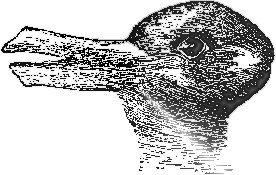
I just think duck-rabbits are neat, so this page is intended as a practical guide to making them, aimed at people who share this interest. When I say below that particular grammatical patterns don't work, I'm just evaluating them within the constraints of this style. This page isn't a demand that everyone writes their crossword clues like this.
About this guide
In UK broadsheet newspapers and some other contexts, the vast majority of clues use a recognisable style of cryptic grammar. The style has its origins in an influential book by an early crossword setter named Ximenes, but it also includes certain conventions and rules that evolved after that. People new to crosswords often ask if "the rules" are written down anywhere, and the truth is that many of these rules are sort of passed down without being documented in one place. Even if you read Ximenes' book you'll find some striking differences between what Ximenes said and what today's "Ximeneans" do, so I would guess most setters' grasp of cryptic grammar comes from real-life conversations or discussions on crossword-solving blogs.
This guide aims to clear things up a bit by listing different grammatical combinations of indicator and fodder and saying whether or not they're commonly seen in this shared style, which we could call Standard Cryptic Grammar. In a sense all I'm doing here is documenting or describing conventions which exist in modern UK crosswords, but I also try to explain why some things are do's and some are don't's (I also point out a handful of conventions of Standard Cryptic Grammar which, to me, don't seem to be very well-founded in ordinary grammar).
As I said, this guide is mainly based around considering different grammatical combinations of indicator and fodder (I've previously suggested these could be called fodules, and luckily this has been embraced by crossword setters everywhere).
Key
Finally, here are a few general principles which I think we can observe in Standard Cryptic Grammar. They're all derived from the golden rule that clues should "say what they mean" (this idea was popularised by Afrit, another early crossword setter who influenced Ximenes, and basically means that clues should express their instructions in ways which can be inferred from how ordinary English works):
- Clues should either describe what the fodder is like, narrate what the fodder is doing, or instruct the solver to do something with the fodder.
- The cryptic reading should present the wordplay as something which is currently happening or something which has the potential to happen, not as something which happened in the past.
- If the indicators used are the kind suggesting an action is taking place, the word order should make it clear who or what is doing that action.
- In terms of cryptic grammar, any bit of fodder should be treated as a noun. (If a solver is asked to anagram the word "walked", "walked" is really a noun referring to the string of letters W-A-L-K-E-D)
- Following from the previous point, any piece of fodder is a singular noun which should perform singular verbs. (If a clue uses "cats" as fodder, "cats" becomes a singular noun referring to the string of letters C-A-T-S, not as a plural noun referring to multiple animals)
- In general, clues where the solver can take the punctuation at face value are more elegant than clues where the solver has to pretend the punctuation isn't there.
💡 Tip: click/hover on grammatical terms marked like this for a quick definition.
Letter selections
The conventions around selecting particular letters from a word are slightly different from those around other types of wordplay, so it makes sense to deal with them in their own section. In general, to indicate letter selections with good cryptic grammar, we want to find a way of naming or referring to part of a word in a way which is comparable to the way you might name or refer to part of an object in real life.
Nouns
Nouns are words which refer to particular things or types of thing, including individuals. They might be in singular or plural form depending on whether they refer to one thing or a group of things.Nouns like "head", "tail", "heart", "sides" and "guts" can refer to particular parts of words. I think the indicators which work best here are nouns which already refer to particular parts of physical or conceptual objects in the real world.
cat's head serpent's tail warrior's heart chef's sides dragon's guts
Patterns like these are totally grammatical ways of referring to particular parts of words, because the possessive apostrophes make clear that the particular head/tail/heart/sides/guts etc we're selecting are the ones which relate or belong to the fodder.
Note that if the indicator is singular like "cat's head", the solver is entitled to assume that they're only being asked to select the first letter from a single word. Equally, a plural indicator like "fluffy dogs' tails" is a clear and precise way to ask solvers to select the tails of multiple words. This sort of precision is a good example of how good cryptic grammar can give the solver information rather than misinformation.
head of cat tail to serpent heart for warrior sides from chef guts in dragon
These are all fine too. The prepositions "of", "to" etc do the same job as the possessive apostrophes in the previous section, by making the relationship between the indicator and the fodder clear in a way which is rooted in normal English (think of phrases like "name of school", "lyrics to the anthem", "present for mum", "ideas from scientist" and "characters in book").
head writer tail bone heart rate side dish gut feeling
We're back with "head astronaut" again. Constructions like this are probably the main source of disagreement in different approaches to cryptic grammar. These would always be avoided by people with a strict approach to cryptic grammar, because in normal speech and writing, "head writer" never means the head of a writer, "heart rate" never means the heart of a rate and so on. In fact, there aren't really any common phrases in English where "[X] [Y]" (with or without a space in the middle) refers to an X belonging to Y, so if you're asking a solver to understand these as letter selection indicators you're asking them to use an invented rule which only exists in crosswords.
cat head serpent tail warrior heart chef sides dragon guts
Many of my crossword colleagues would also reject these because there's still no apostrophe or preposition, but for me the fact the indicator is now after the fodder makes a big difference. While it's rare for English to refer to an X belonging or pertaining to some particular Y with a phrase like "[X] [Y]", there are countless such phrases in the order "[Y] [X]". For example, "city centre" means the centre of a city, and "London skyline" means the skyline belonging to London, and for me that's close enough.
There is a clear argument against the above, but people often do a bad job of communicating it because they just declare things like "party leader" doesn't mean the leader of "party", so let me quickly share an approach that helped me finally understand this one. Imagine having a conversation that's nothing to do with crosswords, then ask yourself which of the following sentences you might use if discussing a word:
- The first letter of PARTY is P
- PARTY's first letter is P
- The head/front/western side/leader of PARTY is P
- PARTY first letter is P
We all know "party leader" is a completely unambiguous term for the leader of a party, but for people who favour this argument, that's sort of irrelevant: the point is that "PARTY leader" is not a phrase you'd use for the first letter of "party" in normal conversation, not because words don't literally have leaders, but because no phrase in the form "[word] [part]" ever sounds natural, even when that part is a totally non-whimsical one like a first letter. "PARTY's leader" and "leader of PARTY" don't have this problem, because they still sound natural.
To sum up, one argument says that if "cat head" can mean the head of a cat then it's not that much of a stretch to treat that phrase as a way of referring to the head of "cat" as well, and another argument says that a small stretch is still a stretch and is therefore best avoided.
redhead cocktail braveheart downsides
Here's another lot where I take a different view from many of my colleagues. There's nothing unusual about using words like "arrowhead" and "pigtail" to refer to parts of an arrow or a pig in ordinary, non-cryptic English, so for me those same words can be interpreted as references to the head of the string of letters "arrow" or the tail of the string of letters "pig". I would draw the line at treating something like "reverend" as a clue for R (the "end" of "rever"), as that's probably just trying too hard.
Interestingly enough this is one where people most people who call themselves Ximeneans are in disagreement with Ximenes himself, who argued that while "redhead" for R is unacceptable because redness doesn't have a head, "masthead" for M is defensible because masts really do have heads (presumably he'd accept "party leader" on the same grounds). I don't think anyone finds this argument very convincing these days, because we all agree that we're talking about the strings "mast" and "red", not actual mastheads or colours. We all agree a word has a head, so the only question is whether "[X]head" is a clear and fair way to refer to that head. Either it is, and any X can slot in there, or it's not, and no X can slot in there.
Adjectives
Adjectives are descriptive words which tell us what something is like, so they usually apply to or "modify" a noun (i.e. a word expressing a thing). What was that sandwich like? It was square, over-priced, delicious, unnecessary – those are all adjectives.Nouns like "head" make it pretty clear which part of the fodder is being selected, but adjectives generally have to be used with a noun such as "part", "letter", "character" etc in order to work well.
cat's first bit serpent's last character warrior's central section chef's outer points dragon's internal parts
These all work exactly like "cat's head" etc from the previous section, except instead of nouns like "head" we have phrases like "first bit" made up of an adjective and a noun. As with the previous section, prepositional phrases such as "first bit of cat", "introduction to cat" and "opener for cat" can also be used, and a minority of people will also accept looser, apostrophe-less constructions like "cat first bit" and "serpent last character".
cat's first serpent's last warrior's central chef's outer dragon's odd
In real life, I can't really say "pass me the big" to refer to a big glass of wine (it has to be "the big glass" or "the big one"). In the same way, many adjectives can't stand alone as ways of referring to particular letters. Some phrases do work, though: ordinals i.e. words which are used to order things numerically ("first", "second", "third" etc) and a few other adjectives relating to order (e.g. "penultimate" or "last"). The key thing is whether these words can work like this in real life: I can say "I choose the first", "he was the third", "the last was the best", but it'd sound odd to say "I choose the central", "he was the outer" and "the internal was the best". Since "cat's first" and "serpent's last" function as nouns (shorthand for "cat's first [letter]", "serpent's last [letter]"), some people will accept these as "cat first" and "serpent last".
cat central serpent inner chef outer dragon odd
As noted, "I choose the central", "he was the outer" and "the internal was best" all sound incomplete, so while some would accept "cat first" or "serpent last", we can't really use that pattern here. Again this is a question of what sounds normal in real life. In real life, you don't typically talk about a part or section of something by positioning an adjective in this way. The oldest member of a family is not "family oldest" etc, the lefthand side of a park is not "park left". Some people might make the argument that "January 1st" means the first of January, so "January first" could mean the first part of the word "January", but that's not very convincing as it relies on taking a very specific usage (which only really applies to dates) and expanding it to things which it wouldn't normally or naturally be used with.
first cousin final countdown central issue extreme views odd jobs
Like "head writer" and "tail bone", these don't work because these phrases wouldn't work like this in real life. "First cousin" would never mean the first piece of a cousin, "middleman" would never mean the middle part of a man, etc. I think things get even more unconvincing and forced if you try to select multiple letters in this way, e.g. if you use "odd jobs" to mean only the odd-numbered letters of "jobs".
From the perspective of cryptic grammar, the word "jobs" is a single thing, albeit a thing made up of smaller things, and normal English grammar doesn't generally let us say "[adjective] [thing]" to mean a particular part of that thing. The string "jobs" is like a street because it's a single thing made up of several smaller things. If you wanted to refer to the odd-numbered houses of a street, it'd be natural to call them the "odd houses", but you'd never use "odd street" to refer to those houses collectively. By the same logic it doesn't really make sense to use "odd jobs" to collectively refer to the odd-numbered letters in that string.
Adverbs
Adverbs generally tell us what way an action was done, so they primarily modify verbs (i.e. words expressing actions). How did you eat the sandwich? I ate it greedily, unattractively, quickly, completely – those are all adverbs.cat primarily serpent finally warrior essentially extremely unhappy internally hired
primarily cat finally serpent essentially warrior unhappy extremely hired internally
While adjective-based constructions like "first day" and "central issue" are seen as bad cryptic grammar, adverb-based equivalents like "day, firstly" or "centrally, issue" are never really questioned. I find that a bit odd, because if the goal is to name or refer to part of a word in a way which is comparable to how you'd refer to a part of something in real life, "firstly, day" and "day, firstly" are no better than "first day". I think the reason we accept the adverb forms but not the adjective ones may be that "first day" definitely looks wrong (because we know "first [X]" would normally mean an X which is first rather than the first part of X), but it's not clear that "day, firstly" would really mean anything in real life, so it's sort of an empty vessel which we can pour a special crossword-specific meaning into.
Ultimately I think "firstly", "finally" etc are probably too useful for setters to give up, but they're also a useful reminder that not everything which is widely used in Standard Cryptic Grammar is simply copied over from ordinary English grammar.
Verbs
Verbs are words which express actions. Verbs typically change their endings to express tense (when the action took place – "jump" vs "jumped") as well as person (who did the action – "I run" vs "she runs").finish race story concludes begin song song begins
The indicators we've seen so far work well because they're ways of naming or referring to particular parts of a word, but verbs don't really produce ways of referring to parts of things. "Charlie's head" names a part of me in the same way that "STORY's conclusion" might name the final letter of "story", but "story concludes" isn't a name for a part of anything – it's a statement. For the statement "story concludes" to clearly communicate that the letter Y is involved in the solution, one of the recognised meanings of "concludes" would need to be "...almost completely disappears, apart from its final part", but really "concludes" can only mean "come to an end, after the beginning, middle etc have been seen too".
The verb "finish" is another good example: "finish race" might look like a way of instructing the solver to take just the last letter of "race", but "finish" doesn't mean to do only the last bit of something (try joining at the finish line and see if people think you've finished the race). "Finish race" is just plonking a word related to finality next to the fodder, without them really fitting together in a logical way.
I do think you can make an argument for using verbs like "start" and "begin" to indicate a word's initial. In real life, we frequently use these words to say that only the first part of something is visible/present/brought into existence. You can tell someone to start or begin a race without requiring them to do the rest of it, so "begin song" seems a coherent way to instruct the solver to begin that word by writing an S into their grid. Similarly, "the film begins" is a coherent way of describing what happens when the start of a film appears on screen, so "film begins" is seems a reasonably clear way to say that the word "film" will begin (but not get any further) somewhere within a crossword solution. Nobody agrees with me though, so that's the end of that.
Single-input wordplay indicators
Several types of wordplay ask the solver to take a single chunk of fodder and transform it in some way. I think of indicators which work like this as "single-input" wordplay indicators, and they more or less share the same cryptic grammar. Examples include anagrams, reversals and homophones.
Sometimes this single input might be made up of several bits of fodder chained together – e.g. reversing AN + REV + AT to make TAVERNA. The key point is that the bits are treated the same way and transformed as one, which is different from two-input types like insertions where one bit of fodder eats another bit of fodder (but more on those later on).
With letter selections, we were generally looking for ways to refer to parts of words, but now we want ways to communicate that words are changing in particular ways. In general we do this with adjectives or adverbs which tell us what the fodder is like (or what it will be like once we're done tinkering with it), or verbs which tell us what kind of action the word will do or have done to it.
Adjectives and adverbs
Adjectives and adverbs are probably the simplest way to indicate single-input wordplay. An adjective or adverb simply goes next to some fodder in order to tell the solver that it will need to undergo some sort of change on the way to the solution.
retrospective view view retrospective friends getting drunk friends but drunk
You can get away using either of the first two orders, though "retrospective view" is probably neater as this follows the usual ordering for modifying a noun with an adjective in English (we say "blue door" not "door blue"). Variations like "getting drunk", "but drunk", "once drunk" are also fine and may help to conjure up more of a story in a clue's surface reading.
In general, comparative/superlative adjectives ("messier"/"messiest") are not used as cryptic indicators, and I think that's because it would be hard to justify what these suffixes would actually indicate. It makes sense to think of an anagram as a messy version of a word, but what does it mean for the fodder to become messier, let alone messiest? Wouldn't all anagrams be equally messy versions of each other? You want everything in the clue to be considered and deliberate, so best to avoid an "-er" or "-est" which can't really mean anything sensible cryptically.
upsettingly blue blue upsettingly
Adverbs are used in much the same way as adjectives, which is actually a bit odd. As mentioned above, any bit of fodder takes on the role of a noun within a clue's cryptic grammar. But the crossword setter Eccles has pointed out, we don't normally apply adverbs to nouns in real life. We use adverbs with verbs ("I wept terribly") or adjectives ("terribly cute"), but not nouns (we don't say "Jeff is terribly").
In pointing this out, Eccles doesn't mean we should all stop using adverbs as wordplay indicators, but it's a useful reminder that some of the conventions which are firmly established parts of Standard Cryptic Grammar rely on stretching ordinary grammar a bit (indeed, we already saw this with "day, firstly"). It's worth saying that some people suggest that, in cryptic terms, phrases like "upsettingly blue" and "blue upsettingly" can be understood as "blue written upsettingly", which addresses "the Eccles heckle" by applying the adverb to an implied verb which is performed by the solver instead of applying it to the noun representing the fodder.
Verbs
This section covers how to use verbs in order to tell the solver that some fodder does something or has something done to it. The cryptic grammar here often hinges on whether a particular verb is transitive or intransitive (see the summary below if you need it).
Transitive and intransitive verbs
Transitive verbs are verbs which must be done to something, e.g. the verb "push over". You can push someone over and maybe even push yourself over, but it's meaningless to just say "I pushed over". I use the word "transport" to remember this: you can't do the action of transporting unless you're doing it to something (a passenger, cargo etc).
Intransitive verbs are verbs which you just do, without doing them to anything or anyone, e.g. the verb to "fall". I can fall and you can fall, but it's meaningless to say "I fall you" or "can you fall that thing?", because nothing can "fall" anything else.
Note that many verbs have transitive meanings in some contexts and intransitive ones in others, e.g. "flip" is transitive in "I flipped the cargo" but intransitive in "I flipped". Verbs like these can work either way in the cryptic grammar, and sometimes a verb that looks transitive in the surface is secretly intransitive in the cryptic grammar or vice versa.
Transitive verbs
Transitive verbs are verbs like "behead", "hate" and "insult" which must be done to something. Within cryptic grammar, transitive verbs are used to show that some fodder is falling victim to some kind of action, e.g. being anagrammed, reversed or transformed in another way.
behead beast
In constructions like this, the solver is essentially being instructed to inflict some wordplay on some fodder: "behead BEAST!". It's a perfectly natural way of expressing that, just like a recipe asking us to "drain pasta" or "chop onions".
beast behead beast beheads
There are two ways you might try to justify this, but neither of them work. You can't read it as a statement that a beast is doing the act of beheading, because beheading has to be done to something, and the beast isn't doing the act of beheading to some other bit of fodder, it's getting beheaded itself. You might also try to read it as an instruction to the solver similar to "behead beast", but with the words back-to-front like this they no longer work as clear instructions: it's like a recipe saying "onions chop" or "pasta drain". You can sort of make it work if you read it as "take BEAST (...and now behead it!)", but having to mentally swim against the current like that and insert imaginary punctuation makes things rather strained and forced.
beast gets beheaded beast when beheaded beast once beheaded
We just noted that "beast" can't simply "behead", because what actually happens is that it gets beheaded. Well, for that very reason, it's fine to use patterns like this which tell us that the fodder will be undergoing the action of beheading. It can be read as "beast gets beheaded [by the solver]".
beheaded beast beast beheaded
These examples are actually just a variant of the [fodder + adjective] pattern we've already seen. That's because "beheaded" is actually functioning as an adjective here – it's describing the word "beast" in a way which is equivalent to a more obviously "adjectivey" adjective like "headless". Verb-derived adjectives like this (called past participles) can be very useful when setting. If the clue includes something like "hero beheaded beast", the surface-level reading will be that a hero did the action of beheading in the past, so solvers will have to work a bit to realise that "beheaded" is in fact being used as an adjective describing "beast". We can use the order "[indicator] [fodder]" or "[fodder] [indicator]", though the former will usually read a bit more naturally.
beheading beast beast beheading
When dealing with transitive verbs, these patterns with -ing words don't really work, because they don't point to the right thing. If we tried to make sense of "beheading beast" as a description, it would logically refer a version of "beast" which is doing some beheading, not a version of "beast" which is getting beheaded. It's the same basic problem as "beast behead": a thing can't simply "behead" (it has to behead something else), so it can't naturally be described as "beheading" either.
You could sort of argue that "beheading beast" refers to what you get when you behead a beast, but that's a bit like a menu saying a dish contains "chopping onions". A slight exception would be if the clue is phrased in such a way that "beheading beast" clearly refers to the process of the solver beheading the fodder. If the clue is something like "Beheading beast makes direction", the link word "makes" allows the clue to be understood as "[The solver performing the action of] beheading BEAST makes [a word for] direction".
beast getting beheaded beast once beheaded beast after beheading beast for beheading
Wordier variations like these are fair and can be useful for injecting a bit more narrative into a surface. They're all the same basic idea as "beast beheaded" and "beheaded beast", in that they refer to the version of "beast" which exists or will exist as the result of the beheading operation. "Beast for beheading" can be read like "asparagus for roasting".
Intransitive verbs
Intransitive verbs are verbs where it doesn't make sense to talk about them being done to something – they're simple actions which someone or something does on their own, like standing, falling or existing. Whereas transitive verbs let us show the fodder has passively fallen victim to something, intransitive ones let us whimsically present the fodder as actively doing something – the fodder isn't just getting anagrammed or reversed by the solver, it's anagramming itself or performing a reversal all on its own.
wolf somersaults wolf to somersault wolf must somersault wolf will somersault
"Wolf somersaults" is perfectly fine as it tells us that the word "wolf" somersaults or reverses as part of the solution. The other variations here are also fine, as they tells us what "wolf" is expected or scheduled to do on the way to the answer. Incidentally, these patterns help illustrate why verbs don't really work for letter selections. The real-life action of somersaulting has a very natural figurative meaning in crosswords, but there are no existing verbs in English which can tell us that e.g. some fodder is removing all its letters except its last letter. "Wolf somersaults" conveys that the fodder must reverse itself, but "wolf concludes" doesn't really communicate that the fodder must delete itself apart from its final letter.
pets somersault pets to somersault pets must somersault pets will somersault
Let's say we want to reverse PETS to get STEP. "Pets somersault" doesn't really work as a way to say that. The word "pets" may look like a plural in the surface reading, but mentioned above, in the cryptic reading it's just the string of letters P-E-T-S, so it needs to be treated as singular ("PETS somersault" is like saying "Stranger Things frighten me" – a word or phrase which superficially looks like a plural may in fact be a title or name for a singlular unit). We can't just make it "pets somersaults", of course, because that'd fix the cryptic grammar but break the surface-level grammar, but this is where these "to"/"must"/"will" patterns come in handy. With these words we can cunningly hide whether "pets" is singular or plural, so the solver can read"pets will somersault" as "pets [multiple animals] will somersault" on the surface level but ultimately understand it as "the string P-E-T-S will somersault" on the cryptic level.
Note that "[fodder] somersaults" would be accurate if the fodder in question were genuinely plural, i.e. made up of separate words. We might use "animals somersault" or something like "a pair of animals somersault" to say that ELK and CAT reverse to make TACKLE.
wolf somersaulted
While "wolf somersaults" is fine, "wolf somersaulted" doesn't work for me. The cryptic reading of the clue should describe the answer to us, which means it should either tell us what the letters in the answer are currently doing or predict what they're about to do. It's weird to use something like "wolf somersaulted", because that can only be understood as a past tense statement. It's like a present-day tour guide saying "Paris was the capital of France" or a maths teacher saying "2 plus 2 equalled 4".
You might ask why we can't treat "somersaulted" as a secret adjective (like the one in "beast beheaded"). It comes down to the difference between transitive and intransitive verbs again. Since "somersault" is not a verb that can be done to something, you'd never say that someone is "somersaulted" or has been "somersaulted". As a result, "wolf somersaulted" doesn't describe the condition of "wolf" in the way that "beast beheaded" describes the condition of "beast".
wolf somersaulting somersaulting wolf
We said "beast beheading" and "beheading beast" didn't work because they'd logically refer to a beast which is doing some beheading, rather than the beast which is being beheaded. In contrast, these patterns do work, because "somersault" is a verb which the fodder can do on its own, without the need for some other victim or object. "Somersaulting wolf" and "wolf somersaulting" are therefore perfectly logical ways of referring to an instance of the word "wolf" which is reversing itself, just as "I saw a car reversing" or "I saw a reversing car" are ways of referring to a reversing car.
somersault wolf somersaulted wolf
Neither of these work, and again it's because somersaulting is the kind of action which cannot be done to something else. While you can behead a beast, you can't somersault something else, so it doesn't really make sense to instruct the solver to "somersault wolf". And while a "beheaded beast" is a beast that's been beheaded, there's no such thing as a "somersaulted wolf" or a somersaulted anything, so the patterns "wolf getting somersaulted" and "wolf once somersaulted" don't work either.
Nouns
Most crossworders working within the Ximenean framework say nouns should not be used to indicate single-unit wordplay. People particularly dislike so-called “nounal anagram indicators” (e.g. “Mozart arrangement” meaning an anagram of MOZART). Obviously “[noun] [noun]” constructions like “tennis ball” and “piano lesson” are perfectly natural in English, but is this pattern valid when one of those nouns represents a string of letters, and can “[fodder] [noun]” provide a clear instruction for solvers? I’m a bit undecided myself but I’ll try to outline both sides in a longer section than normal.
role reversal Tory U-turn film adaptation album version animal sounds
To understand why people dislike these, it’s useful to compare them with how adjectives and verbs work in ordinary English. With some exceptions, phrases in the form “[adjective] [noun]” are usually descriptions saying that the noun in question has a particular quality or attribute (in grammatical terminology, the adjective “modifies” the meaning of the noun). Similarly, phrases in the form “[noun] [verb]s” or “[noun] [verb]ing” are usually statements which say that the noun in question is doing a particular action.
This allows indicator-fodder combos like “[adjective] [fodder]” to describe what the fodder is like, and combos like “[fodder] [verb]s” and “[fodder] [verb]ing” to state what the fodder is doing. This is enough to give the solver an instruction, though I think it’s worth noting that phrases like “wrong trousers” or “nice moves” always need to be interpreted as instructions. The only indicators which literally instruct the solver to do something are recipe-style phrases like “transform [fodder]” or “reverse [fodder]”, which actually appear relatively infrequently.
So how do phrases like “[noun1] [noun2]” work? If you think of examples like “tennis ball”, “piano lesson”, “Shakespeare play” and “birthday cake”, all we can really say is that “[noun1] [noun2]” tells us that the meaning of noun 2 is related to noun 1 in some way. A Shakespeare play relates to Shakespeare differently from how a birthday cake relates to birthdays. Crucially, “Shakespeare play” doesn’t directly express what Shakespeare is like or assert that he’s doing anything: all that phrase directly expresses is the idea of a play that’s related to Shakespeare in some way.
People who dislike nounal indicators have at least two problems with “Mozart arrangement”, then: 1) the indicator word “arrangement” is modified by the fodder MOZART (rather than the indicator modifying the fodder) and 2) the phrase does not directly describe what the fodder is like or state what the fodder is doing.
There’s a certain consistency to the above, but I do think condemning “Mozart arrangement” for not functioning like an adjective-noun or noun-verb combo is a bit like saying tortoises can’t move because they can’t fly or swim. “Mozart arrangement” might not be a literal description of MOZART or a statement about it, but couldn’t it be a name for a particular category of things (i.e. the kind of arrangement which relates to the string MOZART)? Definitions use categories like “country” to ask the solver to name a particular country, and charades use categories like “chess piece” to tell us to find a chess abbreviation, so would asking solvers to name a particular “Mozart arrangement” be so unreasonable? I noted above that “wrong trousers” and “nice moves” aren’t really instructions. If we can interpret those as “you must make TROUSERS wrong” and “you must make NICE move”, why not interpret “Mozart arrangement” as “you must find a particular MOZART arrangement”?
Ah, but maybe I’ve just answered my own question, because the phrase “a particular MOZART arrangement” looks a bit awkward in my previous sentence. Though the “[noun] [noun]” template is common in English, it’s not the case that any pair of nouns can be slotted into that pattern without noticable awkwardness. “Five is a fifteen factor” is not a natural way to say that five is one of the factors of fifteen, so maybe “ROZTAM is a MOZART arrangement” is not a natural way to say that ROZTAM is one of the possible arrangements of MOZART either. Some would say that we’re being led astray by the real-life, musical sense of “Mozart arrangement” here. Ultimately this brings us back to the “cat head” issue discussed during the Letter selections section. "MOZART arrangement" and "CAT head" are strictly speaking not natural or idiomatic phrases, even if "Mozart arrangement" and "cat head" are, but for me the leap isn't unreasonable.
anagram of nice arrangement of Mozart adaptation of film version of album sounds of animal
Most people are perfectly happy with these, because the "of" is seen to tie the wordplay to the fodder in a way that a simple "[noun] [noun]" pattern doesn't. These essentially function as names of categories.
Some nouns work better than others though, and a concept that works well in verb/adjective form won't always work well in this form. For example, while a verb-based indicator like "[fodder] dances" is for indicating an anagram, I don't think "dance of [fodder]" would work very well.
chaos theory error message telephone number radio waves retirement home echo chamber
I don't recall seeing this sort of construction very often. These are like the first "[noun1] [noun2]" group we looked at, but now the fodder is the noun2 slot, so it's arguably being modified by the first noun in a way which is similar to the familiar "[adjective] [fodder]" pattern.
That said, I'm not sure these work that well. In real life, chaos theory is a theory relating to chaos, not a theory engulfed in chaos, so I'm not sure I'd like "chaos THEORY" meaning we need to take "THEORY" and introduce chaos to it. An error message is not a message riddled with error (in fact it's the first step to undoing the error), so I'm not sure "error [fodder]" suggests an anagram well. On the other hand, "radio waves" meaning a word which you might mistake for a synonym of "waves" if you heard it on the radio might be cute. These probably need to be done on a case by case basis.
Two-input wordplay indicators
Above I used the term "single-input wordplay" for types of wordplay which transform a single bit of fodder (or a group of fodder treated as a unit). This section deals with more complex types of wordplay where two bits of fodder (or two lots of fodder treated as two units) interact. Usually it's an unequal interaction where one bit of fodder does something to the other bit.
The most common examples are insertions, where fodder A contains or absorbs fodder B (or where B breaks into or punctures A) and deletions, where A banishes B (or where B departs A). Another example is charade indicators where one bit of fodder goes before/after/above/under/next to another bit of fodder. This sort of wordplay is usually indicated using verbs, as this allows the setter to show present one bit of fodder doing an action to another bit of fodder.
Prepositions
Prepositions (words like "in", "out", "off" and "around" which are mostly used to express how two things or events relate to each other in space or time) are often used to indicate containments, deletions, charades and hidden words, as all of these types of wordplay are basically about how two bits of fodder relate to each other physically.
king out of state king in middle of state king within state king off state king underneath state king atop state king outside of state king next to state
Test
after state, king in state, king around state, kingVerbs
We only have to consider transitive verbs here, because these types of wordplay will always involve one piece of fodder doing something to another piece of fodder.
Transitive verbs
The examples below refer to a containment expressed as A grabbing B, but the same would apply to a containment expressed as B breaking into A, and to deletions expressed as either A banishing B or B departing A.
As there are now two bits of fodder involved there are a lot more combinations to consider. The key thing to remember is to make sure that you put your two bits of fodder the right way around. Obviously "egg grabs cat" isn't a grammatically valid way to say that cat contains egg!
cat grabs egg cat to grab egg cat must grab egg cat will grab egg
Patterns like "cat grabs egg" are probably the most natural way to express two-input wordplay operations, as they provide a clear statement that A does something to B. Again we can also suggest that the wordplay is scheduled or expected to happen, using something like "cat to grab egg".
cat grabbed egg
This can only be interpreted as a past-tense statement, and as I've said before, I don't think that works for cryptic clues. "Cat grabbed egg" suggests that the insertion happened at some point in the past and has now stopped happening, but a clue should really tell us what's currently happening or what's about to happen.
cat has grabbed egg cat's grabbed egg
Whereas "cat grabbed egg" reads like a statement which used to be true and is now false, I think these are unambiguously statements about the present. Both "cat has grabbed egg" and the contracted version "cat's grabbed egg" suggest that this an insertion has taken place and can still be observed in the wordplay.
cat grabbing egg
Just as "somersaulting wolf" refers to a wolf in the process of doing a somersault, "cat grabbing egg" refers to a cat in the process of grabbing an egg.
cat with egg grabbed cat egg grabbed
"Cat with egg grabbed" is similar to "cat grabbing egg", in that it refers to cat which is grabbing or has grabbed an egg. Note that although it uses "grabbed", "cat with egg grabbed" isn't really in the past tense – it's a description of the cat's current state, just like "toy with batteries included". We can also use something like "cat egg grabbed", where the "with" is implied, but this is a bit less elegant as it requires the solver to mentally insert some punctuation to decode it as something like "cat (+ egg grabbed!)" or "cat [with] egg grabbed".
egg grabbed by cat
I see these as the inversion of "cat with egg grabbed": we can read them as "egg that has been grabbed by cat" or "egg that cat is grabbing". Again, it's a description, this time of the egg, rather than a statement set in the past.
egg cat grabs egg cat to grab egg cat has grabbed egg cat's grabbed egg cat's grabbing egg cat grabbing
These are obviously not typical English phrasings, but you can sort of justify them by pointing out that this object-subject-verb order has been used in English in the past – and there's also Yoda, of course. The crossword setter Amoeba has suggested that instead of condemning these as awkwardly phrased full sentences, we should see them as perfectly natural noun phrases pointing at particular objects – after all, we all understand that "the one I love" is a description of someone, not an attempt to say "I love the one". Even with these justifications, I think most people would say that these are less elegant than more straightforward alternatives.
A special case: hidden word clues
Pants containing insect (3) Insect stuck in pants (3) Tarantula eats insect (3)So far in this section we've seen examples of one bit of fodder acting on another bit of fodder as part of the wordplay. Hidden word clues are often clued using transitive verbs too, but with a twist: in these cases, the solution itself is presented as interacting with the fodder which it's hidden in.
In a simple hidden clue like Pants containing insect (3), the fodder "pants" does the transitive action of "containing", but instead of containing another bit of fodder, it contains the answer, which is represented in the clue by the definition "insect". The reverse of this would be a clue like Insect hiding in pants (3), where the solution (again represented by the definition) does the action of "hide" to the fodder.
Ditransitive verbs
The transitive verbs covered so far express that A is doing something to B, but there are also ditransitive verbs which express that A is doing something which involves B and C equally. The verb "give" is an example of this, because the act of giving can only really thought about if one thing (B) is being given to another thing or person (C). In grammatical terms, the sentence "Paul gives Ringo drumsticks" has an direct object (the drumsticks) and an indirect object (Ringo).
I think there are only a few ditransitive verbs which are of any use to crossword setters. For example, the verb "feed" might be used to say that one bit of fodder is fed to or inserted into another bit of fodder, or the verb "deny" might be used to say that one bit of fodder is denied or deprived of another bit of fodder. Note that in these constructions, the unseen 'A' who's doing the action involving B and C is the person reading the clue and solving the crossword!
feed cat egg deny dog love feed egg to cat introduce egg to cat
These are direct instructions telling the solver to carry out the wordplay. Some verbs sound normal in this "feed cat egg" construction, and some don't. And for some phrases, it's possible to reword and add a preposition, but I think "deny egg to cat" would just sound odd, wouldn't it?
cat fed egg dog denied love egg fed to cat egg introduced to cat
These may look like past-tense sentences, but in terms of cryptic grammar they're actually descriptions of the cat/dog/egg, similar to "cat with egg grabbed" etc which I compared to "toy with batteries included" earlier. I find "deny" particularly useful, because on first glance solvers will probably read "dog denied love" in the sense of denying an accusation, before eventually realising it's actually "denied" in the sense of denying someone something they want or need.
dog is denied love dog to be denied love dog being denied love
These are all perfectly sensible too, but let's not push things too far by attempting Yoda-style sentences with ditransitive verbs... A break, give me...
Objects, statements and instructions
The patterns mentioned above cover how bits of fodder fit together with their indicators, but for the next level of cryptic grammar it's also important to think about these indicator+fodder blocks (look, I really think we should just call them fodules) fit together with other indicator+fodder blocks (OK, we don't have to). I think we can identify three basic types of indicator+fodder block, and that can help make clear whether they fit together or not.
There are what we might call objects, which basically consist of some fodder with an adjective or adverb indicator attached. These correspond to noun phrases in grammar. You can tell you're dealing with an object if it'd make sense to say "this clue features..." before it.
This clue features... reversing car odd bits of bus nest with egg in itThen there are statements, which are assertions telling us a fact about the fodder. In grammatical terms these are usually full sentences where the fodder performs a verb. You can tell you're dealing with a statement if it'd make sense to say "It's true that..." before it.
It's true that... car reverses bus regularly vanishes egg goes into nestFinally there are instructions, where you the you the solver are directly told to do some action to some fodder. In grammatical terms these are imperative sentences. You can tell you're dealing with an instruction if it'd make sense to put "you must..." before it.
The solver must... reverse car regularly delete bus put egg into nestYou can press the button below to colour-code all the fodules in this guide according to whether they're objects, statements or instructions.